At the end of a long dark hallway, a faint flickering light of a video projector suggestes the possibility of an image. Using a webcam and infrared lighting, as visitors approach they are offered a mirror reflexion, albeit slightly pixelated and ghostly. This is the "whole" image of narcissus, of the viewer as interactive participant.
- Installation: The Thousand Faces of Buddha
- Online link: The Thousand Faces of Buddha
- Concept + Development: Douglas Edric Stanley
- Production assistant: Pierre-Erick Lefebvre
- Exhibition: Arborescence 2003
- Location: Moulin de la recense, Ventabren, France
- Date: 1 October, 2003, 19h
- Video: The Thousand Faces of Buddha
Note: This old piece — one of my first — has been updated here on this website for the modern era of face detection, using the Mediapipe Face Landmark detection system. Back in the day, my face detection methods were far more rudimentary. Try it here: The Thousand Faces of Buddha.
This is a piece that I developed as an experiment in 1999 and despite a small installation at a parisian squat, had yet to really be shown in public. When Aborescence asked if I could present something at the Moulin de la recense (a beautiful old mill, just down the street from my house, in fact), I decided to pull out this old project.
The idea is to build a simple program for each installation, no saving allowed (we used an APS battery backup system). Once the program is finished, the installation runs until someone pulls the plug.
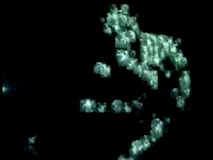
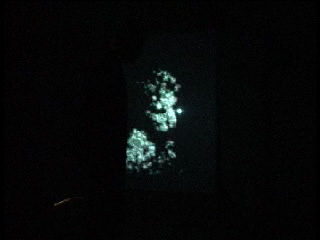
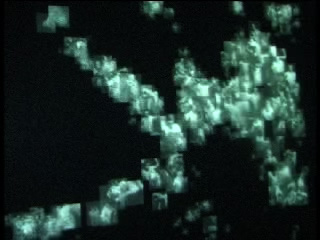
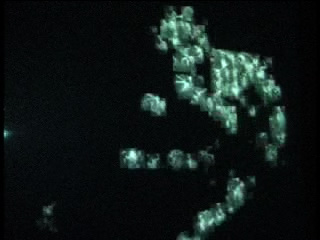
At the end of a long dark hallway, a faint flickering light of a video projector suggestes the possibility of an image. Using a webcam and infrared lighting, as visitors approach they are offered a mirror reflexion, albeit slightly pixelated and ghostly. This is the "whole" image of narcissus, of the viewer as interactive participant.
But with each new visitor to this mirror, the webcam takes a picture and integrates the new image into the program. Each of these images is then used to build up the fragmented individual pixels that compose the whole image.
Once 1000 images have been recorded, the system randomly overwrites an older images with a new one.
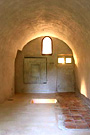
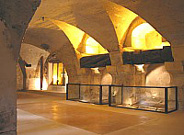
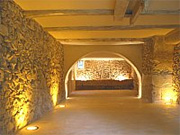
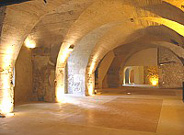
The installation takes place in the “Chapel” of the Moulin de la recense.
////////////////////////////////////////////////////////
Our machine reveals itself in three stages. To identify them, let us use three terms from our vocabulary: réactivité, relation, and récursivité.
At the end of a dark corridor, a faint light flickers: the promise of an interaction. As one approaches, this light becomes active and forms figures composed of rather coarse pixels. This is the first stage of the machine, that of réactivité: I move my body, and pixels dance in response.
From within this abstract dance of pixels and movement emerges the second stage, that of relation: a kind of Gestalt figure, since the moving pixels are in fact arranged according to an orientation that mirrors our own bodily physiognomy. This is one of the most reassuring figures produced by réactifs systems: that of the mirror (cf. Trash Mirror, Wooden Mirror, Reactive Books, Mirror Mirror).
Gestalt — an apparent contradiction. Gestalt psychologists describe perceptual space as “anisotropic,” that is, fundamentally asymmetrical. Unlike the physicist’s space, the phenomenologist’s space is heavier at the bottom than at the top, denser behind objects than in front of them, and different on the right side than on the left. Obviously conceived in the image of the human subject — subjected to gravity, oriented frontally, favored on the right — it constitutes a projection of that subject, returning to the spectator their own virtual image, as in an invisible mirror. Yet Gestalt psychologists also describe this same space of experience as fundamentally centered and, as such, resolutely symmetrical, since radial symmetry, produced by multidirectional rotation around a point, represents the most complete form of spatial equilibrium.
– Yve-Alain Bois and Rosalind Krauss, Formless: A User’s Guide, 1996, pp. 83–84.
The disparate pixels collectively form our own image. A mirror, then, from which we emerge out of darkness through the mediation of an infrared camera.
Finally, from this mirror a third logic emerges, announcing the third stage of the machine: récursivité. For the system does not merely retransmit our image in real time; it also uses its camera to capture images of each participant and accumulate them in a volatile database. This database is temporary but collective: it contains 1,000 images of those who have looked into the mirror before us. When it reaches capacity, the oldest images are overwritten by new ones — beginning with the designer of the program during its initial tests (image no. 1), followed by assistants (no. 2), exhibition curators (no. 3, …), venue technicians, and finally anonymous spectators, who gradually displace the system away from the author’s primary narcissism and populate it with their own faces as they encounter the work.
Within the machine, there is thus a ruban (cf. Turing Machine) that records the movements of spectators. Yet it is only upon closer inspection that each pixel detaches itself from the Gestalt figure, allowing us to perceive that it contains the faces previously captured by the mirror. This third stage of the machine is the most fragile, and in fact eludes at least a third of viewers, who are often driven by a voracious impulse to consume artworks. Only by slowing down one’s movements and perception does this third image emerge, revealing the discreet witnesses of the bottomless récursivité that afflicts the image once it has been seized by the algorithme.
