For the past three years I have been leading a series of workshops around a concept we call “folding worlds”. Most of these experiences involve building virtual reality experiences using the Unity game engine and various VR headsets. A parallel group — run by Laurent Novac, Joana Huguenin, and (previously) Marie Dommenguet — has also been exploring these concepts via experiments with the Unreal game engine.
The general concept is simple: take physical manifestations of the world, and “fold” them into a virtual experience. From there, it is also possible to “fold” the virtual experience back out into a physical manifestation.
We evolved this concept of “folding” into and out of virtual spaces by starting from Gilles Deleuze’s description of the general Leibniz concept of consciousness and how it folds external stimuli into windowless internal “room” or “upper floor” of harmonic perception:
Leibniz constructs a great baroque montage that moves between the lower floor, pierced with windows, and the upper floor, blind and closed, but on the other hand resonating as if it were a musical salon translating the movements below into sounds up above. – Gilles Deleuze, The Fold, p.4
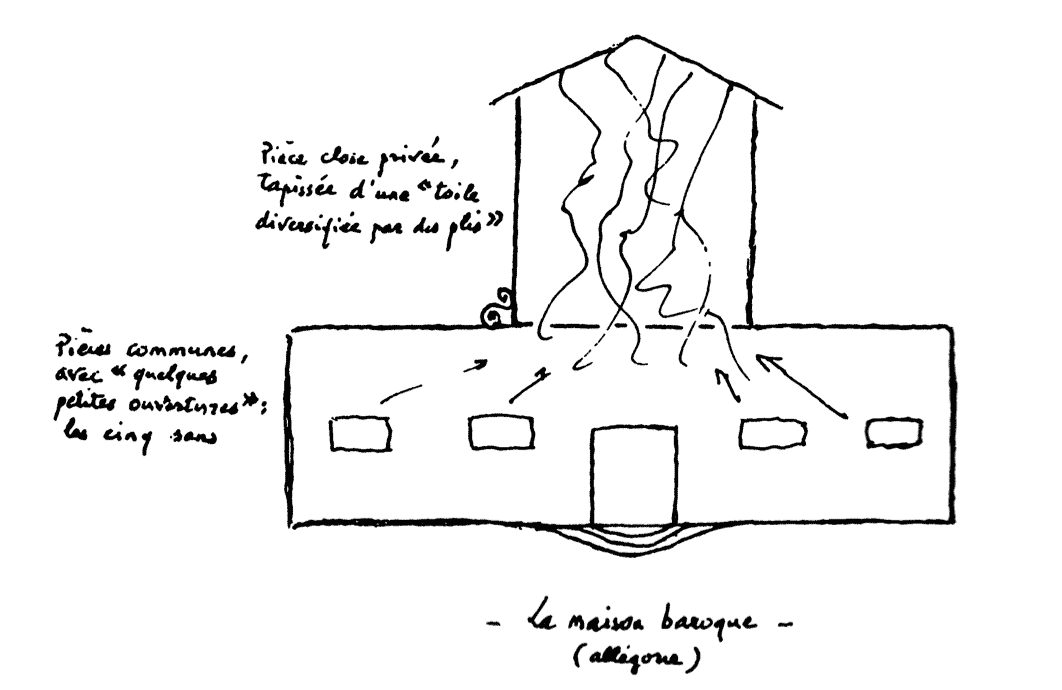
Our proposal is that we can stretch Deleuze’s allegory into our contemporary condition, as we place odd technological devices over our heads — covering our eyes from the visible world — and explore it anew through virtualized algorithmic experiences.
From our brief:
This project is about scanning the physical world, and creating possible interactions with that world inside of virtual reality. In this project you will build a physical maquette and/or object that you will scan and import into an Oculus VR headset using a game engine. The goal is to create simple and poetic interactions with this world. The idea is to find simple interactions using hand gestures that fold and unfold the story of your object and/or world. The sound of these interactions will be an important component to your project. Your sounds should be — think ASMR — physically felt, although immaterial.
- Folding Worlds: folding between tangible & digital worlds
- Department: Master Media Design, HEAD – Genève
- Department director: Alexia Mathieu
- Equipe enseignante: Sabrina Calvo, Camille Dedieu, Joana Huguenin, Laurent Novac, Pierre Rossel, Douglas Edric Stanley
This annual workshop centers on developing interactive experiences in virtual reality, a key focus of our Master’s in Media Design in Geneva. Students gain a foundational understanding of game engines, such as Unreal Engine and Unity, while placing a strong emphasis on narrative design. They learn to create immersive user experiences that utilize simple interactions to convey meaningful stories.
The methodologies employed vary depending on the project brief. For instance, students might scan the physical world to develop interactions in virtual reality, construct physical models or objects to be scanned and imported into an Oculus VR headset using Unity, or fulfill commissions for exhibitions like Présence Suisse in Osaka 2025.
Our students engage with a diverse range of topics, including guiding a creature through a paper maze, escaping the darkness of an abyss with the aid of light, and rediscovering the enchanting world of Heidi through a playful, paper-crafted landscape.
Selected projects:
- Abyssal Encounter
- Margot Herbelin, Dorian Jovanovic
- 2023
- Creepy cutouts
- Faust Perillaud, Tibor Udvari
- 2023
- Ali Lenti
- Andrés Acosta-Blaschitz, Mathilde Schibler, Jonas Wolter
- 2024
- Johanna's Spyrit
- Sarah Meylan, Enzo Seurre, Adam Chatir
- 2024
- Murmuration
- Naomi Blidaru, Océane Serrat, Lauren Thiel
- 2024
- Cerna
- Amaury Hamon, Tomislav Levak
- 2023
- Whispering Rose
- Michelle Ponti, Marine Faroud Boget
- 2023